Serengeti
Dates Duration Available Effort Level Price Important Application Form

Northeast Tanzania is a wonderland, from Africa's highest peak to the most spectacular wildlife landscapes on the planet.
Kilimanjaro and the Serengeti are the trips to remember for a lifetime. Fabulous landscapes, green hills and mountains.
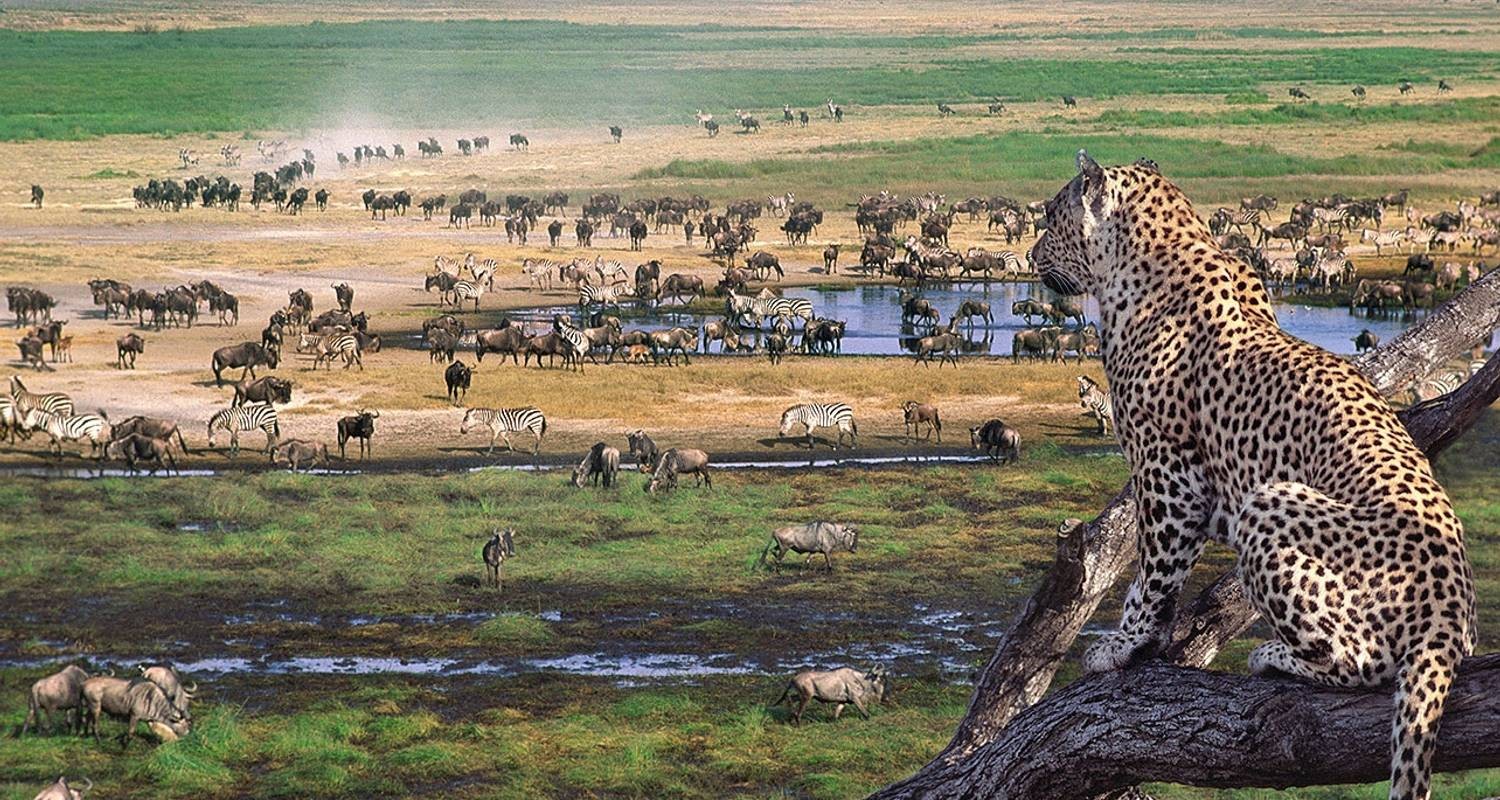
Tarangir - the kingdom of boa baboons and elephants, Lake Manyara with lions, flocks of pink flamingos and rhinos around Lake Matron. A tour at the foot of the Ngorongoro Pass that will show us the land as it was at the dawn of humanity along with an unforgettable encounter with the Maasai.These things make Northeast Tanzania one of the most exciting and emotional destinations in Africa. Serengeti National Park - a panorama of wild animals with the greatest diversity on the planet.
Ngorongoro National Park - Descent into a lost world of wildlife with incredible green-blue landscapes. Tarangir is the second national park in the world with the highest concentration of wildlife in the world after the Serengeti. Home to the largest population of elephants in the world, around 700 lions, the more difficult to see leopards and cheetahs, herds of buffalo, zebras, Thompson's antelopes and Tanzania's symbol, the giraffe.
Lake Natron with numerous pink flamingos and spectacular views of the Ol Doinyo volcano.The city of Arusha is the gateway to the northern safari circuit with the national parks of Tanzania, also called the capital of Tanzania safaris offering the opportunity for unforgettable encounters with the unique nature of Africa. The city is located at 1,300 meters above sea level, near Mount Meru.


Tanzania

Serengeti
Trekking
km
hotel/hostel
3000 Altitude

Instructor, three meals per day, group equipment, first aid kit, eating a full board, camping/hotel nights, transfer to exit point, entrance to national and nature parks, breakfast

food in cafe and restaurant, Airline tickets, production of visas, additional services, single room supplement, Medical insurance, - Входните такси за посещаваните обекти; - Медицинска застраховка - 20лв.
  • Program
  • Description
  • Preparation
  • Reviews
  • Map
date_created
2024-02-04 08:18:43
Day
1
Language_route_program
English (en-GB)
Day Description
Arusha city
We will pick you up at Kilimanjaro International Airport, transfer to the city of Arusha (45 km), relax, eat and spend the night at the Two Mountains lodge, from which you can see the two highest mountains in Africa - Kilimanjaro and Meru.

days_photo
Arusha
Arusha
View to Kilimanjaro
date_created
2024-02-08 23:34:00
Day
2
Language_route_program
English (en-GB)
Day Description
Tarangire National Park “the largest elephant’s population in northern circuits”
Located 128 km away from Arusha.
Land size covers 2,850 square kilometers.
Rich in history during colonial period, among notable was the ex-husband of the Karen Blixen-author of Out of Africa.
A Maasai steppe land known for its number and size of elephants i.e. the high elephant density.
Lemiyoni,Matete,Tarangire hill and Silale swamps are truly favorites places for sightseeing and game
The park offer clear breathtakingly sunrise and sunset and attracts spectacular wildlife, big cats, variety of bird species, trees, termite mound and magnificent baobab trees are common throughout the park.
Breakfast, by 10:00am depart for Tarangire national park, arrives.
Proceed with game viewing till sunset.
Evening relaxation, dinner, bush fire and a night rest at the tent/Tarangire national park campsite.
Standard quality camping gear- a tent, mattress, pillow, bed sheet, mosquito repellent, towel, sleeping bag.
Campsite has flush toilet, shower and security.
days_photo
National park Tarangire
date_created
2024-02-08 23:34:00
Day
3
Language_route_program
English (en-GB)
Day Description
Sunrise Wildlife Encounters, To Flamingos Paradise
This morning after a room tent coffee/black tea/milk service (recommended time: 06:00am), proceed with morning game viewing till 11:00am.
You will get to see large quantity of wildlife, varieties of bird’s species, trees as well as geographical features. The morning exploration provides a great chance to see plentiful of wildlife.
Tarangire river view point would be a perfect place for an outdoor breakfast. While taking breakfast you will be detailed about pre, during and post colonial history of Tarangire national park.
Then take on African baobab tree story you will be detailed about life, history, uses and African cultural perception and depiction over baobab tree (myths & superstition).
By 12:00hrs drive to Lake Natron, about 184 km, this route takes inexactly 3-4 hours long, pass along extra ordinary western wall of Great Rift valley, mountainous zone on the way, active and alive volcanic mountain, Oldoinyo Lengai “Mountain of God”
(Lastly erupted in March 2008).The only mountain that is currently erupting carbonatite lava.
Outdoor bush lunch, arrives,unpack,relaxation.
Outdoor bush lunch arrives,unpack,relaxation.
Evening relaxation, dinner and a night rest at Masai Eco lodge.
days_photo
Lake Natron
Masai eco lodge
Ol Doinyo
date_created
2024-02-08 23:34:00
Day
4
Language_route_program
English (en-GB)
Day Description
Day 3:
Masai Village & Waterfalls
Morning walk to the true Maasai village; explore their culture, hut, daily living, age-sex group rank and duties, you will be detailed over Maasai social organization and its origin in East Africa.
Breakfast.
Then walk to the waterfalls, an ideally place for swimming.
Hot goat barbeque lunch.
Relaxation, early evening walk for photograghy around Natron lake landscape,dinner and a night rest at Masai Eco lodge.
days_photo
Masai eco lodge
Lodge
Lodge
date_created
2024-02-08 23:34:00
Day
5
Language_route_program
English (en-GB)
Day Description
To Serengeti National Park
LAKE NATRON
A soda lake with a maximum depth of 3 metres, 57 kilometres long and 22 kilometres width.
It is a lesser flamingo main nesting site in East Africa with alkaline water that has a pH as 10.5, sometimes reach 12.
A terminal lake that do not drain out to any river or sea, about 2 million flamingoes use the lake as their regular breeding ground.
This morning; get to see flamingos at a closer range, getting to know habits and interesting facts, a walk along the alkaline lake, spend 2 hours.
Leave for Seronera-central Serengeti via Klein’s gate, Lobo-eastern Serengeti: in this area herds of elephants,buffalo,klipspringers on the kopjes,impala,hartebeest,gazelle,warthogs and predators are commonly seen, en route game viewing on the way, enjoying amazing scenic on the way, get to see animals while travelling plus more to admire in passing.
This route provides an amazing series of change of environment, ranging from a real forest, rocky hills to a great endless plain. Pass the Lobo valley and surroundings hills and kopjes and game viewing.
Visit Retima hippo pool, get to encounters school of hippos at very closer ranger, here you will be detailed why hippo do more killings than lion do in Africa.
Evening calmness, dinner and a night rest at the Cottage-Seronera .
days_photo
The gate of Serengeti
Axes
Cottage Seronera
date_created
2024-02-08 23:34:00
Day
6
Language_route_program
English (en-GB)
Day Description
Full Day In Serengeti National Park “land of the endless plains”
Land size covers 14,763 square kilometers.
Incredibly beautiful area, diverse in habitats with a high number of species to entertain and observe.
Seronera-central Serengeti
Reliable area to find a wide variety of game throughout a year because t has permanent pools of water that are home to hippos.
The Most Pleasant Time To Visit:
Central Serengeti/Seronera; throughout a year.

Today morning we will do a game viewing around Seronera plain, provides a great chance to see plentiful of wildlife- ranging from big mammals, numerous bird species, plain vegetation and geographical features e.g. a small hill, kopjes.
Take a savannah breakfast. Get to hear inner history of Serengeti. Packed lunch.
Continue with wildlife encounters till 1830hrs.
Evening calmness, dinner and a night rest at the Cottage-Seronera .
days_photo
National park Serengeti
date_created
2024-02-08 23:34:00
Day
7
Language_route_program
English (en-GB)
Day Description
Half Day In Serengeti,To Ngorongoro
Keep your eyes out for countless wildlife encounters.
After breakfast, then wildlife encounters in Seronera valley.
Get to admire the great view point “land of the endless plain” at Naabi hill.
Leave for Ngorongoro, enroute game viewing.
Arrives, with time to settle in prior to dinner and a night rest at Simba campsite.
Standard quality camping gear- a tent, mattress, pillow, bed sheet, sleeping bags, towel.
days_photo
National park Ngorongoro
National park Ngorngoro
date_created
2024-02-08 23:34:00
Day
8
Language_route_program
English (en-GB)
Day Description
Down Into Ngorongoro Crater-Arusha.
By 05:45am you will get a morning coffee/black tea/milk service to combat cold weather (at 2000’s meters above sea level)
This early morning, by 06:00am we will drive to Seneto gate for descending into Crater for superb sunrise game viewing.
While go down, we can then admire the landscape, rock and vegetation.
Ngorongoro Crater is known as Garden of Eden, there is nowhere else on this earth where you can see, in such ease and comfort, such a spectacular accumulation of wildlife in such a splendid and unique setting.
Ngoitoktok hippo swamp would be a perfect place for an outdoor breakfast-you will be detailed about a history of Ngorongoro.
By 11:30am ascends time.
Stopover at heroes point “photographer’s paradise”, catch a glimpse of Ngorongoro caldera “crater”.
Coffee farm exploration.
Evening calmness, dinner and a night rest at Tow Mountains lodge or Eco lodge.
End of tour.
days_photo
National park Ngorongoro
View to Kilimangaro
Arusha
date_created
2024-02-04 08:18:43
Language
English (en-GB)
Reservation and payment
To reserve a place in a group, must fill out a form, buy tickets and make a prepayment of 100 euros, and the remainder will be paid in Chamonix in EUR (€).
Additional costs
It will be approximately € 110-150 and will partly depend on your campaign preferences. In fact, it will be the price for travel, camps and additional dishes. We try to reduce the extra costs, but this is not always possible.
How to fly and where the meeting is
The group will meet the instructor in Chamonix, which can be reached by a direct bus from Geneva (tickets can be purchased online) or from another city in France or Italy. You may arrive at Chamonix almost at any time, anyway, we will stay in one of the camps for the night. The instructor will welcome you to the bus station or we will send you detailed directions on how to get to the campsite (if we spend the night at the campsite near the bus station). We will spend the last night of a trip to Chamonix so you can pick up return tickets with early departures
Documents, currency, communications
For citizens outside the European Union: To visit France, you will need a valid passport (valid for another 6 months after the end of our trip) and a Schengen visa to be obtained in advance (usually takes about 30 days). We will provide you with the necessary documents for the visa (description of the English itinerary and accommodation data), but you will have to pass the documents on your own (if you have never registered before, we will consult you).
During the trip, we will visit 3 countries - France, Italy and Switzerland, on whose territory you can and will have to pay in euros (EUR). Do not be surprised, even in Switzerland in the border region easily can pay with euro. In most cases, it will be possible to pay by credit card with rare exceptions.
Communication is the biggest problem on this route so far, as buying 3 different SIM cards is not entirely rational. That's why we recommend buying a passenger SIM that can be complemented by Wi-Fi at cafes and campsites.
Weather and equipment
As always, the current weather forecast will be 3-4 days before the trip, earlier forecasts are not very accurate.
We try to choose the least time when there are few more tourists in the mountain. It leaves its mark on the pedestrian crossings around Mont Blanc at different times of the year.
Summer: At the beginning of the summer, the Alps are already warm, although it is still possible to see snow over 2,000 meters (especially in shady areas). Air temperature in the mountain valleys rises above +20 during the day, but can climb to +10 (at high passes) while climbing. At the same time, during the night in the valleys, the temperature may fall below +5 (possible freezing). Almost all the nights we planned in the mountain valleys, so that at night it is relatively warm (although much will depend on time).

Autumn: The mountains are still warm and during the day often the temperature exceeds +20, but it is cooler at night, but the temperature rarely falls below +5 in the mountain valleys.
In the high mountains, precipitation is almost always possible, so special attention should be paid to protection against moisture (good membrane shoes, membrane clothing and raincoat pocket covering the backpack at the same time). At the same time, at the beginning of the summer there may be a small layer of snow, so the obligatory ghettos are (covering the legs, which prevent the snow from entering the shoe). Additionally, do not forget to pick up trekking poles, the excursion is full of downhills and climbs.
Here are references to the weather forecast that will be suitable for 3-4 days before the trip:
Chamois As usual, the current weather forecast will be 3-4 days before the trip, earlier forecasts are not very accurate.
We try to choose the least time when there are few more tourists in the mountain. It leaves its mark on the pedestrian crossings around Mont Blanc at different times of the year.

Summer At the beginning of the summer, the Alps are already quite warm, although it is still possible to see snow over 2,000 meters (especially in shady areas). The air temperature in the mountain valleys rises above +20 during the day, but it can drop to +10 (as the climbs pass) while climbing. At the same time, during the night in the valleys, the temperature may fall below +5 (possible freezing). Almost all the nights we planned in the mountain valleys, so that at night it is relatively warm (although much will depend on time).

Autumn In the mountains is still warm and during the day often the temperature exceeds +20, but it is cooler at night, but the temperature rarely falls below +5 in the mountain valleys.

In the high mountains, precipitation is almost always possible, so special attention should be paid to protection against moisture (good membrane shoes, membrane clothing and raincoat pocket covering the backpack at the same time). At the same time, in the beginning of the summer, the money is partly covered with snow, so mandatory ghettos are (leg covers that prevent the snow from entering the shoe). In addition, do not forget to pick up trekking sticks, the excursion is full of ups and downs.

Here are references to the weather forecast that will be suitable for 3-4 days before the trip:
Chamonix - Chamonix
Courmayeur - Courmayeur
Mont Blanc (2000 m) - Mont-Blanc / forecast / 2000
Kurmayer
Accommodation and meals
During the trek we will spend the night in tents and we will often stay in camps with hot showers and wireless internet. We will have a hot breakfast (sweet oatmeal with dried fruits or pasta and cheese), lunch (oatmeal with meat) and evenings (soups / borsch) + tea, chocolate, biscuits. At the same time we will buy some of the products along the way, diluting our diet with local products (cheese and wine).
We will bring some of our products to us. They will weigh up to 5 kg and we will hand them over to you before departure or who wants to buy their own (their costs for the products that subtract from them the cost of the price).
Discounts
For early bookings, we have promotional discounts that are recorded in the questionnaire when filling in. The number of promotional places is limited, so we recommend filling in the forms as soon as you decide to go with us. In addition to the promotional, we have the usual discounts that you can choose when filling in the questionnaire (about the company, experience, etc.)
Language
English (en-GB)
date_created
2024-02-04 08:18:43
Personal Belongings
1. Tickets, documents, money (all in a sealed package).
2. Mammals, elastic bandage (mandatory) and medications for chronic diseases (if any).
3. CSB (cup, spoon, bowl) - preferably metal, maybe plastic.
4. Spotlight (it is desirable that each participant has, but you can do with one in a tent).
5. Products for personal hygiene (toothbrush and toothpaste, wet and dry wipes, toilet paper, etc.).
6. Small, fast drying towel.
7.Solar glasses with UV protection.
8. Sun Protection Cream.
9.Mobile phone, camera, etc. (It is advisable to provide protection against moisture in the hermetic packaging).
10. Container for drinking water (the size depends on your needs).
Personal camping equipment
1. Rucksack (50-80 liters) - Dimensions depend on the volume of your belongings and equipment place for products.
2. Sleeping bag - Comfort temperature should be 0 ... 5 (depending on current forecast) and weight is 1-1,5 kg.
3. Double Layer Tent (where top tethering and inner tent are not in contact), weighing up to 1.2 kg per person seat (up to 3.6 kg for 3 people). If you have free space in the tent, write about it before the trip so that you can share a neighbor with you who can share the weight.
4. Resistant mat (foam, caramel).
5. Telescopic sticks, comfortable during downhill runs.
6.Gety - protection from moisture and dirt between shoe and leg.
7.Hairproof bag (to protect the most valuable items in the backpack).
8.Spotlight
Shoes and clothes
1. Trekking boots with Gore-Tex membrane and Vibram sole. In this shoe
you will spend most of the day, so it is very important to be stable, comfortable and "high" (firmly fixed ankle).
2. Shoes (light sandals or rubber flip-flops) for parking lots and more.
3.Heavy-duty clothing (trousers, T-shirt, long sleeve T-shirts, light jacket). Clothes should not hold the movements, breathe and dry a fast-membrane (like Gore-Tex), jacket and trousers protected from rain and wind. Membrain clothing can be replaced with raincoats, but you need to take a few pieces, or even better, take a poncho to cover you and your backpack.
4. Warm clothes: two warm softshell jackets, warm pants (women's half), warm socks (at least two pairs), gloves and a hat.
5. Changing clothing: underwear, T-shirts and socks.
6. Hats for protection from sun, wind and rain ( buf). Even with a minimal amount of sun in the mountains, you can burn.
General Equipment
1. Cooking dishes.
2. Gas burners and gas bottles.
3. Dipper and cutting board.
4. Match, lighters, knife, first aid kit, map, GPS.
This is important!
The weight of personal equipment (personal belongings, personal camping equipment, shoes, and travel clothing) will increase the weight of the products (about 0.5kg per day), so leave space in the backpack and choose lightweight and practical things.
Experience
It is desirable that you have previously be in camp a tent and that you can walk 10 km for an hour in of road.
How to prepare?
Climbing and cross-country running can be considered as perfect training. Kneeling will strengthen the muscles of the legs and will not hurt you after the first ascent. You can squat at home in the evening, preferably 100-150 times in several series. The cramps should start 2 weeks before the start of the tour, believe me, your body will be grateful for this. As far as running on a terrain is concerned, it's hard to replace it with something, but you can just run to the stadium or ride a bicycle. This, though it does not strengthen your ankle, but will help you train your heart before you go (you will be less busy than the thin air).
What is a lap - continuous climb and descent. During our trip we will have several mountain passes and several mountain valleys. Climbs to the passageways will be on average difficult paths, so we will often climb and descend on a steep slope and therefore we need to strengthen the ankle.

Only reviews written on the currently active language site are displayed. To see the rest, please select a different language.

Trekking
No records